The Impact of Digital Media Entrepreneurship on News Credibility in India: A Contemporary Analysis
The news industry in India is going through a massive transformation. For decades, traditional television channels and print newspapers were the main sources of information for millions of households. Today, cheap mobile data, affordable smartphones, and high-speed internet have completely disrupted this old setup. India has become a mobile-first market where consumers spend nearly 80% […]
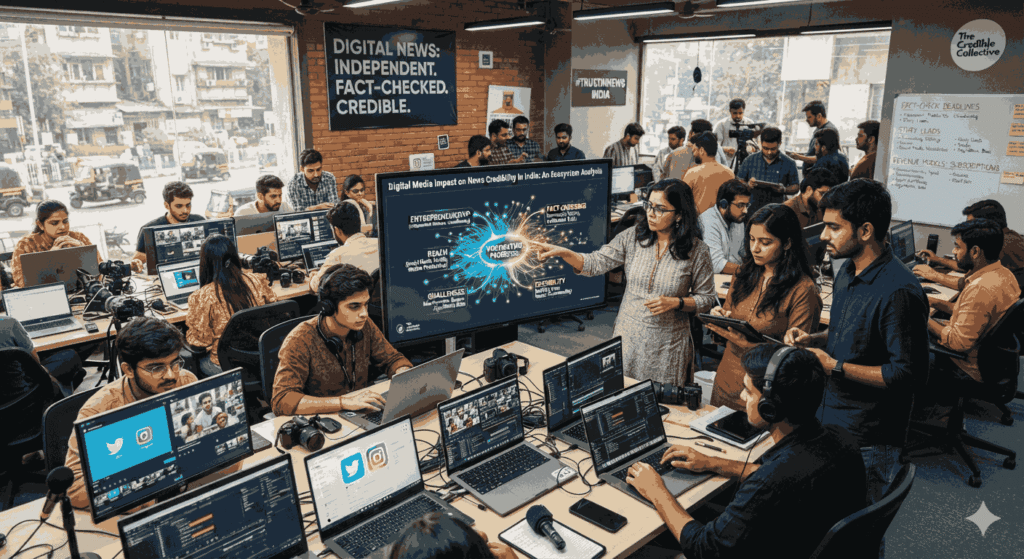
The news industry in India is going through a massive transformation. For decades, traditional television channels and print newspapers were the main sources of information for millions of households. Today, cheap mobile data, affordable smartphones, and high-speed internet have completely disrupted this old setup. India has become a mobile-first market where consumers spend nearly 80% of their mobile application time on digital media and entertainment.
At the same time, traditional broadcast journalism is facing a severe trust crisis. Mainstream TV news is increasingly viewed as loud, biased, and heavily influenced by big corporate owners and political interests. This trust gap has created a unique opportunity for digital media entrepreneurs. Many veteran journalists and independent creators are starting their own digital platforms, news portals, and YouTube channels to deliver independent, public-spirited news. However, these new digital ventures face serious challenges in building long-term financial models and navigating a highly restrictive regulatory environment.
The Trust Deficit in Traditional Broadcast Journalism
Traditional TV news channels in India have slowly shifted from investigative reporting to performative entertainment. Prime-time TV debates are often loud, hostile, and designed to generate high television rating points (TRPs) rather than inform the public. Instead of asking tough questions to the government, many mainstream networks have become highly aligned with political narratives, leading to a visible drop in journalistic objectivity.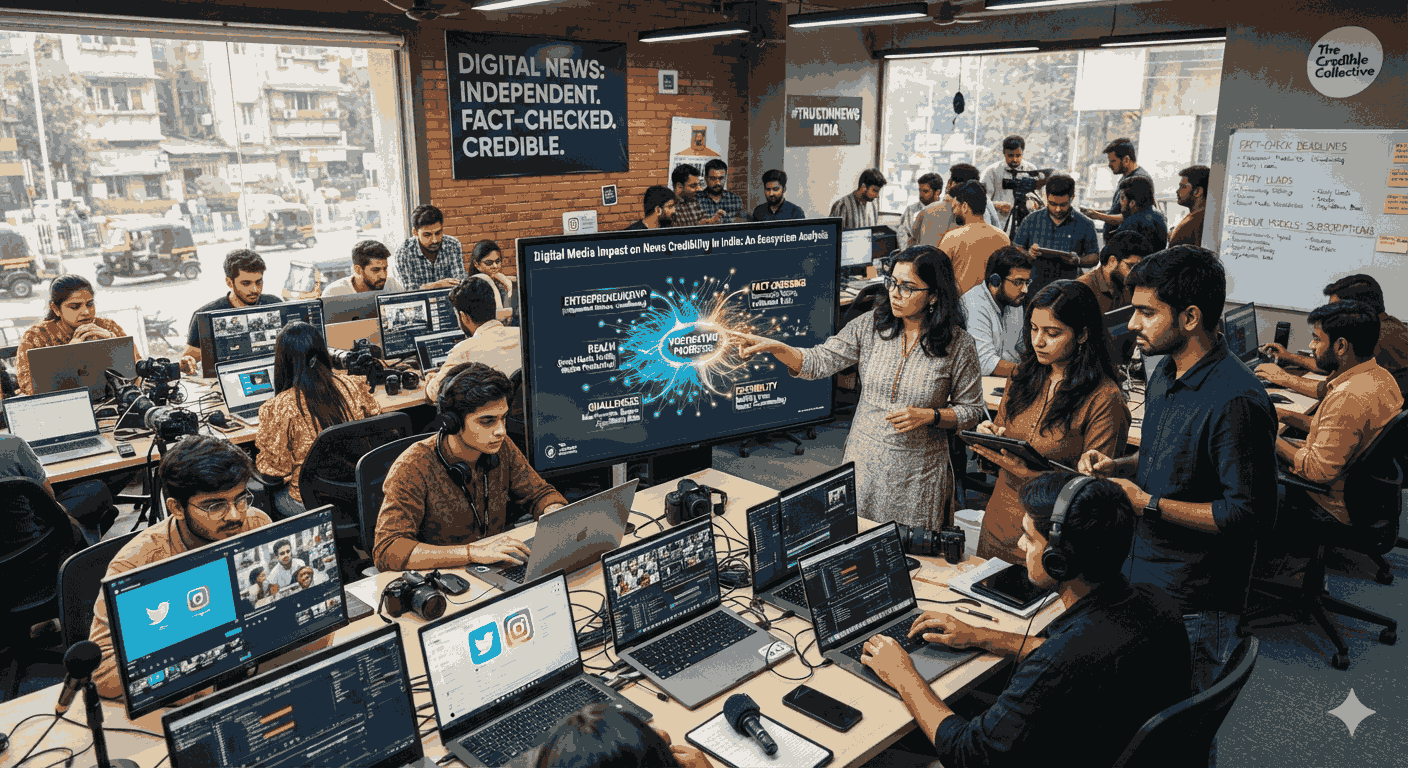
This change is not accidental. Mainstream media in India is heavily dominated by large corporate conglomerates. These businesses have strong economic incentives to keep the government happy to protect their other business interests. This dynamic has forced many legacy newsrooms to practice deep self-censorship, choosing to ignore critical stories that might embarrass the powerful.
This corporate-political alignment has also fueled social division. Mass TV media has frequently been used to broadcast highly polarized, sensationalist programming. For example, media monitoring groups like the India Hate Lab documented 668 hate speech events targeting minorities in 2023. Out of these, 36% directly called for violence, 25% targeted religious places, and 63% promoted conspiracy theories like “love jihad” and “land jihad”. About 75% of these events took place in states ruled by the leading political party, showing how closely mainstream narrative-building aligns with political agendas. This ongoing polarization has caused a steady decline in India’s performance on international press freedom monitors, as shown in the table below.
| Year | India’s Rank in World Press Freedom Index | Key Systemic Pressures Identified |
| 2023 | 161st out of 180 countries | Legal harassment of independent reporters, rising majoritarian narratives, and corporate takeover of legacy TV channels. |
| 2024 | 159th out of 180 countries | Increased weaponization of financial audits, tax raids, and use of anti-terror laws against critical newsrooms. |
| 2025 | 151st out of 180 countries | High concentration of media ownership in politically connected hands; survival of legacy outlets tied to conditional financing. |
The Rise of Platform-Based and Creator-Led Journalism
Because of the decline in mainstream news quality, Indian news consumers are moving online in massive numbers. This digital migration has turned platforms like YouTube into a major parallel news ecosystem. Today, India has the world’s largest YouTube audience, with more than 491 million to 518 million active users. This scale has completely transformed how people consume daily news, especially when compared to traditional television.
| Medium of Consumption | Estimated Active Audience | Core Content Strategy | Trust & Engagement Dynamics |
| Traditional TV News | ~360 million viewers | Hourly news bulletins, live studio debates, and heavy commercial advertising. | Trust has declined due to perceived political bias, sensationalism, and high-volume debates. |
| YouTube News Channels | ~600+ million users | Long-form explainer videos, direct-to-camera commentary, and regional language news. | Higher perceived credibility; audiences appreciate the independent tone, interactive comments, and direct connection with hosts. |
This platform shift has allowed veteran journalists to escape corporate control and build independent personal brands. When mainstream NDTV faced a hostile takeover by a politically connected billionaire group in 2022, senior editor Ravish Kumar resigned. He moved his reporting entirely to YouTube, where his personal channel quickly grew to over 14 million followers. On his digital show, he regularly criticizes media bias and highlights systemic issues like unemployment and rural distress. Other popular journalists, such as Abhisar Sharma, run successful YouTube channels with over 9 million subscribers, explicitly marketing their work as a way to hold the powerful accountable.
Alongside legacy journalists, a new class of digital-native explainer creators has emerged. Creators like Dhruv Rathee produce research-driven video essays simplifying complex political and social topics. His highly discussed 2024 video, “Is India becoming a Dictatorship?”, drew over 26 million views by criticizing media suppression and the misuse of state agencies against opposition leaders. Other popular creators, such as Nitish Rajput and the husband-and-wife duo Abhi and Niyu, focus on presenting balanced, multi-perspective content to encourage critical thinking among younger viewers.
However, this platform-based news model has its own set of problems. YouTube and Instagram rely on algorithms that reward high engagement and emotional reactions. This algorithmic setup has turned these platforms into breeding grounds for misinformation and hate speech. Many unverified creators pretend to be journalists and spread highly damaging communal rumors and fake news.
Furthermore, social media companies are often very slow to act against viral misinformation. A joint investigation by Access Now and Global Witness revealed that YouTube approved 48 ads containing explicit election-related disinformation and voter obstruction in English, Hindi, and Telugu during the 2024 elections, directly violating its own policies.
There is also a significant gender gap in this creator-led news space. Out of the top 16 most-mentioned news influencers in India, 14 are men, showing that women face unique social and cultural barriers when trying to build independent digital news brands.
Exploring Startup Business Models and Financing Structures
For digital media startups to survive, they must move away from the traditional ad-based business model. Relying solely on programmatic digital ads is highly unpredictable because major tech giants like Google and Meta capture the vast majority of digital ad spending. This dynamic forces ad-dependent sites to run clickbait articles to maximize page views, which ultimately destroys their journalistic credibility.
To break this cycle, Indian media startups are experimenting with diverse funding models. In the early stages, many of these ventures rely on structured crowdfunding, private equity, or debt financing to build their initial infrastructure.
| Financing Strategy | Target Business Stage | Core Mechanism | Practical Application for Media Startups |
| Equity Crowdfunding (e.g., Pepcorns) | Early-stage scale-up | Founders sell small equity stakes to a pool of individual retail investors. | Helps tech-enabled media platforms raise pre-seed capital from their most loyal readers. |
| Revenue-Based Debt (e.g., Recur Club) | Growth stage with steady cash flow | Platforms provide non-dilutive debt financing, with repayments scaling alongside company growth. | Ideal for media startups with established subscription models that want to grow without diluting equity. |
| Hybrid Crowdfunding (e.g., Catapooolt) | Launching a new product or show | Startups combine reward-based crowdfunding with equity options based on market demand. | Useful for launching specialized investigative series or digital-native video channels. |
| Donation-Based Crowdfunding (e.g., Ketto, Milaap) | Non-profit or social impact projects | Platforms raise capital from contributors with zero expectation of any financial return. | Essential for hyper-local or regional language newsrooms covering social issues. |
By leveraging these funding options, several digital-native newsrooms have successfully launched subscription-based and reader-supported news models.
The Ad-Free Subscription Model
Platforms like Newslaundry operate entirely without corporate or government advertisements, relying instead on a reader-supported subscription model. To build their digital app in 2023, Newslaundry bypassed commercial advertisers by raising Rs 15 lakh through a direct community crowdfunding campaign. This user-funded app has allowed them to acquire over 50,000 paying subscribers, giving them the financial freedom to produce deep investigative reports, media critiques, and ad-free podcasts without editorial interference.
The Success of Bundled Subscriptions
Convincing price-sensitive Indian consumers to pay for news remains a major hurdle, especially since free alternatives are easily accessible online. To overcome this challenge, Newslaundry and The News Minute (a prominent digital platform covering Southern India) collaborated to offer a bundled subscription plan.
Using a paywall management system powered by the technology provider Quintype, readers could subscribe to both platforms for a single price. This collaboration yielded remarkable results: within just five months of its November 2023 launch, the bundle achieved a 214% spike in subscription counts and a 243% increase in revenue. This success demonstrated that independent digital newsrooms do not have to compete against each other; instead, they can grow their revenues by working together.
Regulatory Frameworks and Self-Regulation Initiatives
As the digital news ecosystem grew, the Indian government began setting up strict legal frameworks to regulate online content, raising concerns about press freedom and state overreach.
To show that the digital media industry can regulate itself responsibly without government interference, independent publishers established the DIGIPUB News India Foundation in 2020.
DIGIPUB’s Self-Regulatory Framework
DIGIPUB is an independent body that represents digital-only news publishers, freelance commentators, and independent journalists. The foundation has established a strict internal Code of Ethics and formed a Level II Self-Regulatory Body under the IT Rules, 2021.
Led by highly respected figures—including former Supreme Court Judge Justice Madan Lokur, activist Bezwada Wilson, and social advocate Swarna Rajagopalan—DIGIPUB is officially registered with the Ministry of Information and Broadcasting. The body reviews and addresses public complaints regarding digital news content, striving to maintain high standards of journalistic ethics.
The Information Technology Rules, 2021
The primary regulation governing digital news in India is the Information Technology (Intermediary Guidelines and Digital Media Ethics Code) Rules, 2021. These rules require online publishers of news and current affairs to:
Set up a clear grievance redressal mechanism with a designated Grievance Officer.
Submit monthly compliance reports detailing the complaints received and the actions taken.
Adhere to a strict Code of Ethics overseen by the Ministry of Information and Broadcasting.
Under Rule 16 of these guidelines, the government has the power to block online content on an emergency basis. Free-speech advocates have strongly criticized these rules, calling them unconstitutional. Various digital portals, including LiveLaw and the Press Trust of India, filed lawsuits challenging the rules in different High Courts, resulting in multiple stay orders against the enforcement of the Code of Ethics provisions.
State Countermeasures and Legal Pressures
Despite judicial protections, digital media startups face constant pressure from the state. The government has increasingly used tax audits, regulatory investigations, and security laws to target critical newsrooms.
The Unmaking of Not-For-Profit Newsrooms
One of the most concerning trends is the targeted revocation of tax-exempt status for independent, non-profit newsrooms. In late 2024, tax authorities rescinded the non-profit status of The File (a Kannada-language portal focusing on government accountability) and The Reporters’ Collective.
The government canceled their exemptions under Sections 12A and 80G of the Income Tax Act, claiming that investigative journalism does not serve a “public purpose” and classifying them as commercial entities.
This move had devastating financial consequences. Without these tax exemptions, donors are discouraged from contributing, and these newsrooms face massive retroactive tax liabilities. For example, The File was forced to let go of its video production staff and halt its video channels, illustrating how bureaucratic tax decisions can quietly shut down independent journalism.
The Income Tax Act, 2025 and Digital Search Powers
This regulatory pressure has been further strengthened by the Income Tax Act, 2025, which was passed by Parliament on August 12, 2025. This new law significantly expands the search powers of tax officials.
Under Section 247, authorities can search a journalist’s “virtual digital space”—including cloud accounts, emails, personal phones, and chat history—based on mere suspicion of tax evasion, without needing to present credible evidence beforehand.
Furthermore, Section 249 prevents officials from disclosing the reasoning behind their search, making it incredibly easy for the state to access confidential whistleblower files and expose sensitive journalistic sources.
The NewsClick Case and Ultimate Judicial Vindication
The most high-profile example of state action against the digital press is the case of NewsClick. In October 2023, the Delhi Police conducted a massive operation, raiding the homes of over 70 journalists and staff members associated with the site, seizing their devices, and sealing their offices.
The portal’s founder, Prabir Purkayastha, was arrested under the Unlawful Activities (Prevention) Act (UAPA), India’s primary anti-terror law, following allegations that the platform had received foreign funding to run Chinese propaganda. This action devastated the outlet’s finances, forcing it to freeze its bank accounts and lay off its staff.
However, the courts eventually intervened to protect the journalists. In May 2024, the Supreme Court declared Purkayastha’s arrest illegal and ordered his release. Following this, on May 29, 2026, Justice Neena Bansal Krishna of the Delhi High Court completely quashed the Economic Offences Wing’s (EOW) FIR and the Enforcement Directorate’s (ED) money laundering cases.
The High Court ruled that because no foreign investment restrictions existed for digital media at the time of the funding agreement in 2018, no laws had been broken. The judge noted that the prosecution had failed to establish any evidence of cheating or criminal conspiracy, calling the state’s case a “gross abuse of the process of law” and a direct attack on free and impartial journalism.
Legal Pressures on Individual Creators and Commentators
While independent news organizations have faced institutional crackdowns, individual creators and influencers are also facing severe legal pressures. Operating without the institutional backing and legal teams of traditional newsrooms, these independent creators are highly vulnerable when they make reporting mistakes.
This vulnerability is clearly visible in the rising number of defamation cases and court directives targeting digital creators:
The Supreme Court Directive on Social Media Conduct (August 2025): Following a controversy on Samay Raina’s comedy show India’s Got Latent, where inappropriate jokes targeted persons with disabilities, the Supreme Court bench of Justices Surya Kant and Joymalya Bagchi issued a directive to the government to frame strict conduct guidelines for online influencers. The court ordered the comedians to issue public apologies and remarked that social media influencers often “commercialise free speech” and “have the capacity to hurt sentiments”. During these proceedings, creator Ranveer Allahbadia faced multiple police complaints and was temporarily banned by the court from posting any content on social media, highlighting how quickly a personal brand can be silenced.
Adani Group Defamation Cases (September 2025): In Gujarat’s Gandhinagar district, a court issued summons to independent journalists Abhisar Sharma and Raju Parulekar following criminal defamation complaints filed by the Adani Group. The complaint against Sharma was linked to an August 18, 2025 YouTube video where he claimed that thousands of bighas of land in Assam had been allotted to the conglomerate as a political favor. Sharma based his claims on a Gauhati High Court order from August 12, 2025. However, the court order actually centered on Mahabal Cement, a subsidiary of JK Lakshmi Cement that has no connection to the Adani Group. If found guilty of defamation, both journalists face up to two years of imprisonment, demonstrating the immense legal risks that independent creators face when reporting on powerful corporate groups without institutional legal support.
Synthesis and Future Outlook
The rise of digital media entrepreneurship has fundamentally changed how credibility is defined in India. Traditional TV networks have largely lost public trust, allowing independent creators and digital startups to step in as alternative watchdogs. By proving that readers are willing to fund independent reporting through subscriptions and crowdfunding, these platforms have shown a viable way forward for honest journalism.
Yet, the digital press faces a highly uncertain future. The state is increasingly using targeted tax regulations, virtual search powers, and criminal defamation laws to make critical reporting financially and legally unsustainable. At the same time, the spread of unverified misinformation on social media platforms threatens the overall credibility of the online news ecosystem.
For digital media entrepreneurship to survive, startups must work together to strengthen self-regulatory bodies like DIGIPUB. They must also build highly professional, accurate newsrooms and secure diverse funding streams. Only by maintaining the highest ethical standards and financial independence can India’s digital newsrooms continue to defend free speech and hold the powerful accountable.

Last updated on July 25, 2026. This article represents the author's views.